


Gonzo and gonzo journalism are terms coined by—and, in truth, exclusively owned by—my old literary mentor, Dr. Hunter S. Thompson, blessed in memory. The term is said to have been used for the first time in Thompson’s magnificent The Kentucky Derby is Decadent and Depraved, published in Scanlan’s Monthly in June 1970, his first gonzo chronicle. The following year, in 1971, the expression was immortalized in Fear & Loathing in Las Vegas, where Hunter’s heavyweight Samoan lawyer goes by the name “Dr. Gonzo.” The word “gonzo” derives, at least in my interpretation, from “gone”—one is “gone,” far away, tripping, stoned, elevated in a higher state above petty-bourgeois rules and conventions.
Read/see much more about my gonzo writing e-book collection En svensk gonzo (A Swedish Gonzo) here, and about our “gonzo release party” here!
Hunter S. Thompson published a long suite of collections, including Fear & Loathing: on the Campaign Trail ’72, Generation of Swine, The Great Shark Hunt (a must!), Better Than Sex (a favorite!), The Rum Diaries, Kingdom of Fear (another highlight!), and more. The last was Hey Rube from 2004. Thompson shot himself in his home in Woody Creek, Colorado, on February 20, 2005.
Gonzo has come to be associated—primarily by those who haven’t read Hunter S. Thompson closely—first and foremost with alcohol, drugs, and even sexual debauchery. I find this unfortunate. Certainly, alcohol and various types of drugs are important components of this literary tradition and of the mental states that gave rise to it. Sex, on the other hand, plays at best a secondary role.
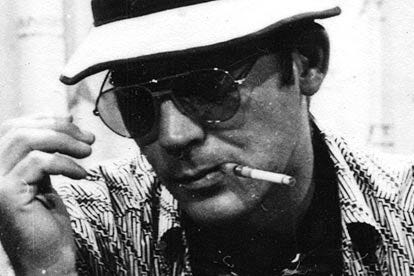
For me, gonzo is above all about breaking free from traditional objectivity, to allow one’s own personality free rein—picturing reality through that personality and its inner monologue of associations, fantasies, hallucinations.
The literary style that Hunter S. Thompson single-handedly invented is rooted in 1950s Beat literature, Ken Kesey, and the “LSD poet,” Timothy Leary. Not least, I would argue, it draws inspiration from William S. Burroughs’s unrestrained maelstrom of delirious visions. Thompson ramped up the style with his very own, updated animation for the the television and rock ’n’ roll age. In my view, he’s primerely an outstanding portrayer of American society and the diseased American collective psyche.
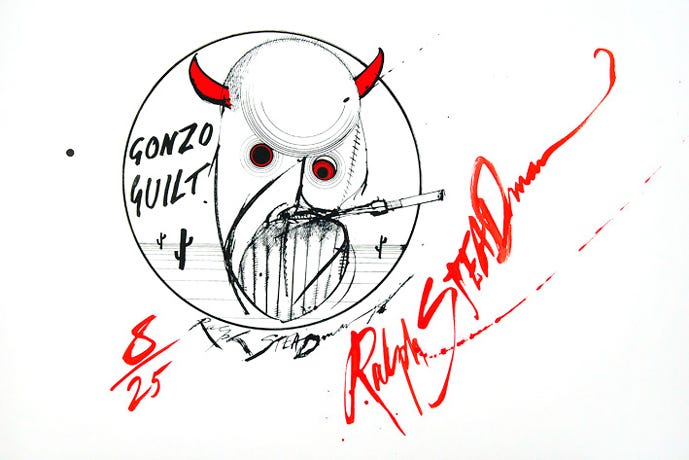
I myself took the plunge for the first time back in 1994, casting aside supposed journalistic objectivity to write fully in the gonzo tradition—in my own highly personal, Swedish-style adaptation. I’ve continued ever since. For me, this expression offers greater freedom—broader opportunities to recount our contemporary reality as I see and experience it, in a truer, more honest sense than if I were to don the straitjacket of conventional, often phony, contrived objectivity.
”His hallucinated vision strikes one as having been, after all, the sanest”
–Nelson Algren on Hunter S. Thompson

Related articles:
En svensk gonzo

2016 utgav jag, i samarbete med Albert Bonniers förlag och min dåvarande förläggare Martin Kaunitz, e-boksamlingen En Svensk gonzo. Samlingen består av en serie på inte mindre än 24 e-böcker med texter på svenska som jag har publicerat i olika medier under åren 1995-2016, tillsammans med några nya jag skrev för utgivningen. Samt…
En svensk gonzo (A Swedish Gonzo) book release

It was a truly memorable, intimately personal, appropriately wild and crazy evening celebrating my e-book anthology En svensk gonzo in our BrittonBritton studio on Regeringsgatan in Stockholm, in the company of a small circle of friends, collaborators, publishers, editors and old classmates.
En svensk gonzo (A Swedish Gonzo) presents: my treasured collaborators—and my personal “gonzo manifesto”!

I compiled this list of mini profiles of some of my closest creative collaborators ten years ago, for the launch of my e-book collection En svensk gonzo in winter 2016. The list is still relevant, so no reason to change anything. However, more collaborators may be added. Please excuse the skewed gender balance…I’m afraid there’s no…
