

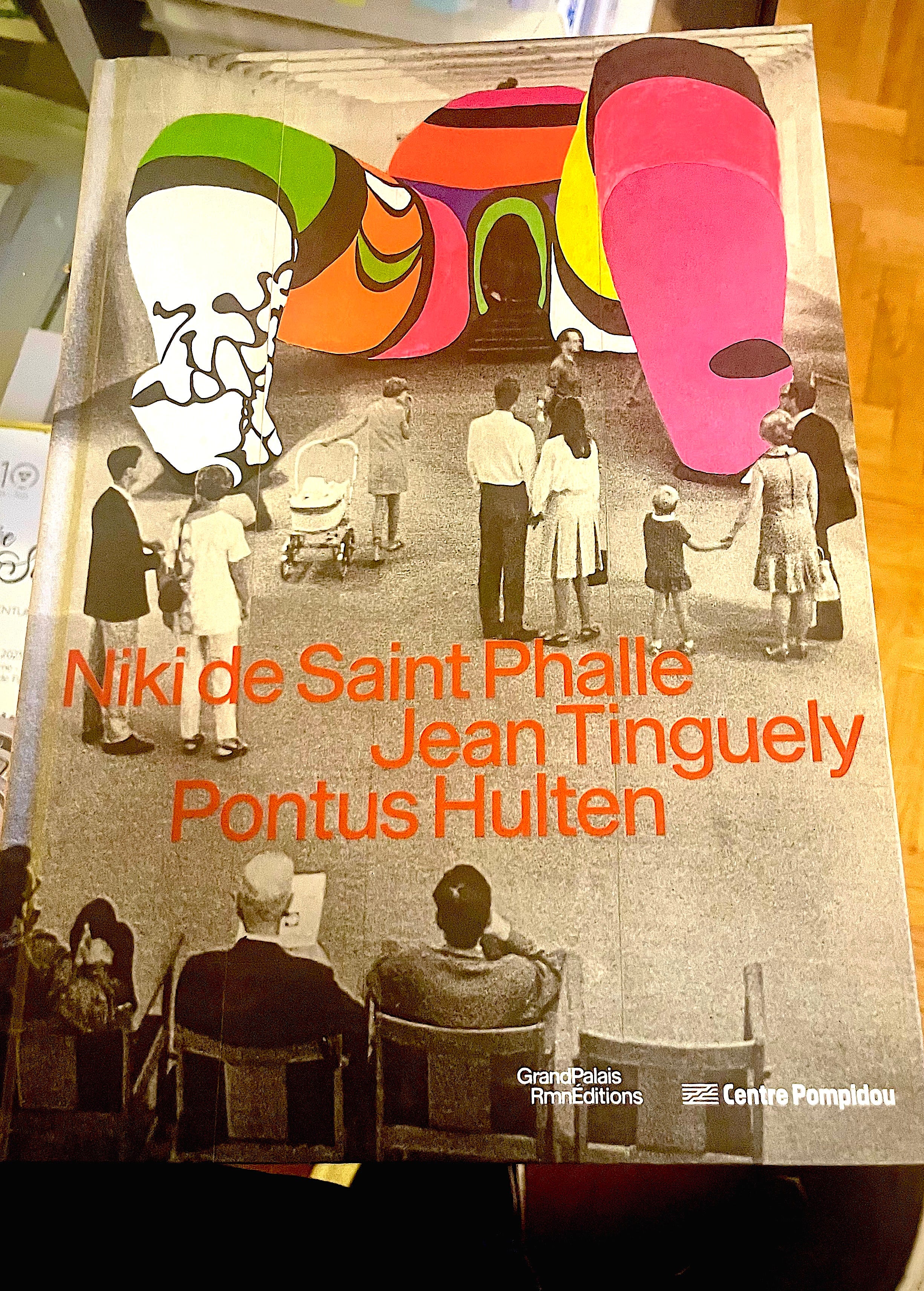
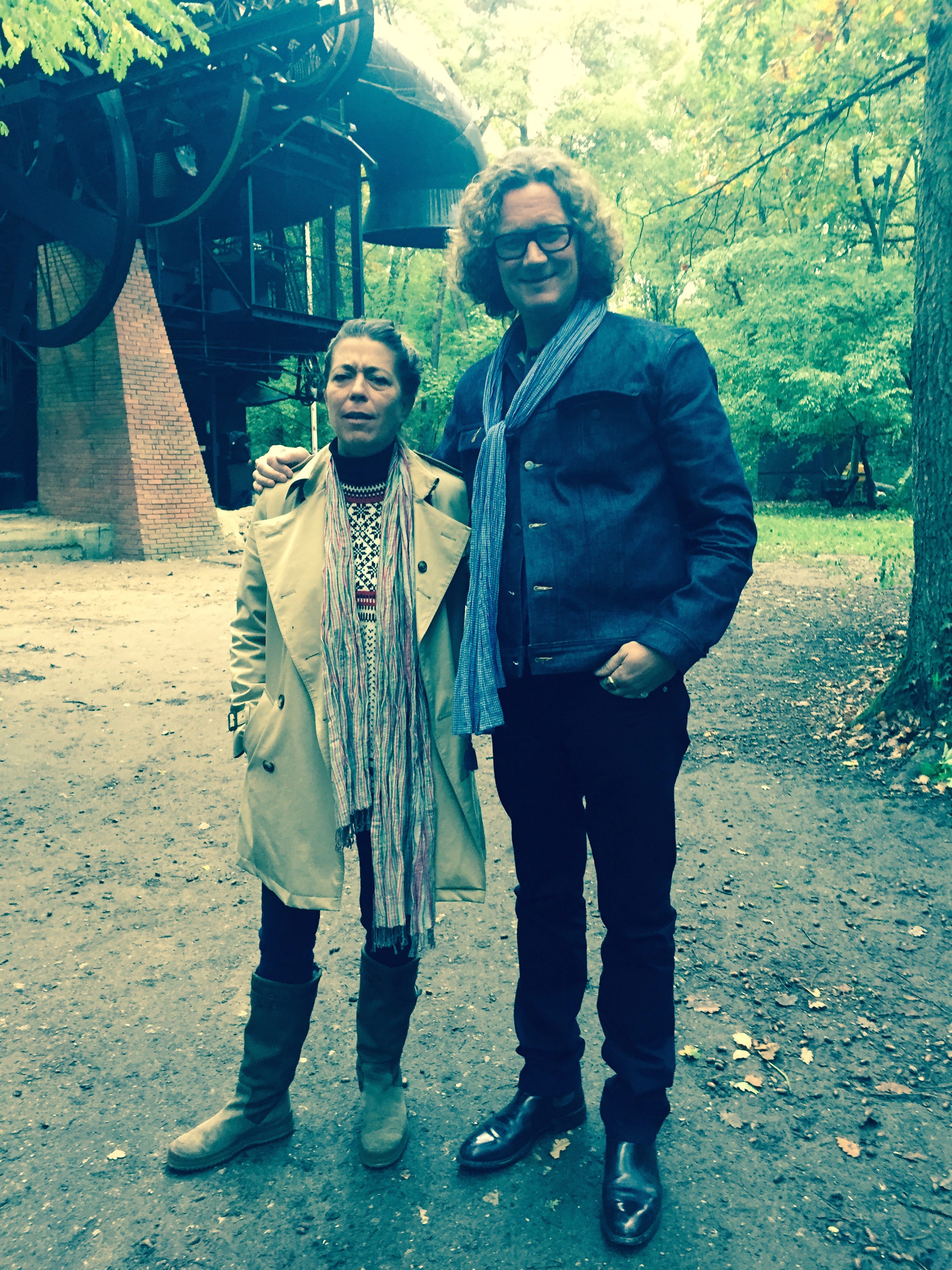
My entry for the catalog for Centre Pompidou:s blockbuster exhibition Niki de Saint Phalle, Jean Tinguely, Pontus Hultén, presented in the Grand Palais in Paris June 2025-January 2026. The catalog (and the text) is available to order in French and English editions.
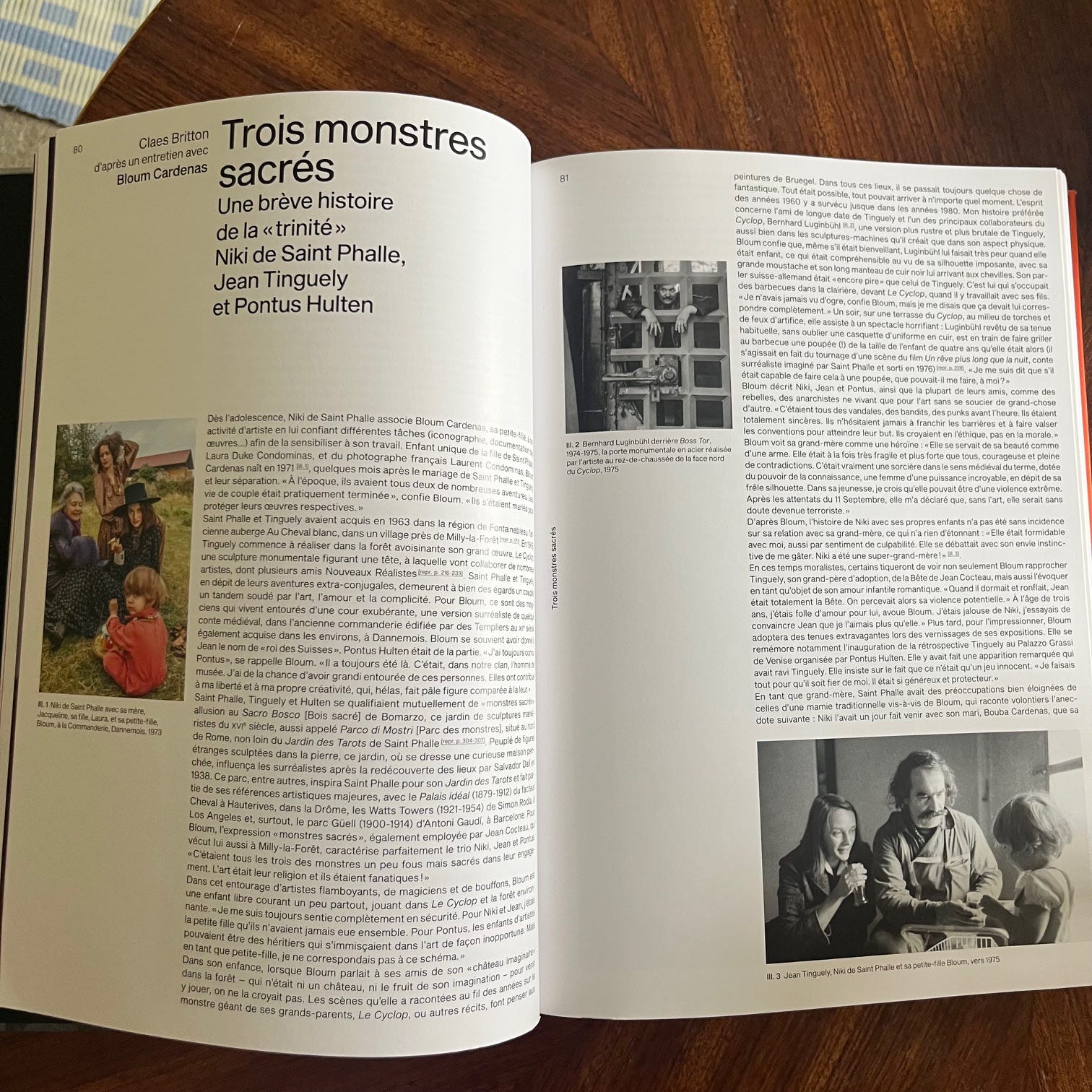
Bloum Cardenas was groomed from childhood by her grandmother Niki de Saint Phalle to manage the artist’s creative afterlife. In her testament, de Saint Phalle named Cardenas trustee not only of her own artistic rights, but also of those of Jean Tinguely, whose estate Niki had inherited when her husband and partner passed away in 1991.
The lone child of Niki’s daughter Laura Duke Condominas and French photographer Laurent Condominas, Bloum Cardenas was born in 1971, just months after Niki and Jean had finally married—and separated. “By that time, they both had many other lovers—their private life together was practically over”, says Bloum. “They married to protect each other’s art.”
Niki and Jean lived in the Commanderie, a templars’ quarters from the twelvth century in the village of Dannemois in the Fontainebleau forest. In 1969, Tinguely started his life’s work Le Cyclop, the giant monster head sculpture, which involved many of his fellow noveaux realistes and other artist friends, near the adjacent village of Milly-la-Foret.
Other lovers regardless, de Saint Phalle and Tinguely remained, in many ways, a couple, a team, united in art, love and camaraderie. To Bloum, they were both her magic grandparents, the royal couple of a wild, exuberant court that gathered in the Commanderie; a surrealistic take of a Medieval fairy tale. Pontus Hultén was a regular in this clan. “I’ve always known Pontus”, Bloum says. “I don’t ever remember him not being around, a cornerstone in the culture, like the great uncle of the family. I’m blessed to have grown up with these people. They are part of my freedom to be secure with who I am and with my own creativity, which unfortunately is pretty lame compared to theirs.”
Sacred monsters, a term that Niki, Jean and Pontus used for one another, alludes to Sacre Bosco (sacred groove), the mannerist sculpture garden from the 1500s in Bomarzo in Italy’s Lazio region, north of Rome, also known as Parco di Mostri, the park of monsters, not far from Niki’s Giardino dei Tarocchi in southwest Tuscany. The garden, with monster sculptures carved in rocks and a distorted tower, influenced the surrealists after Salvador Dalí “rediscovered” the garden in 1938. It’s one of the sites that inspired Niki for Giardino dei Tarocchi, part of her pantheon of outsider art references along with postmaster Ferdinand Cheval’s Palais Ideal in Hauterives in central France, Simon Rhodia’s Watts Towers in south central Los Angeles, and, above all, Antoni Gaudi’s Park Güell in Barcelona.
To Bloum, this expression, sacred monsters—also used by Jean Cocteau, who lived in Milly-la-Foret—perfectly captures the trio Niki, Jean and Pontus. “They were monsters all three of them, a bit crazy but sacred in their commitment. Art was their religion—and they were fanatics!”
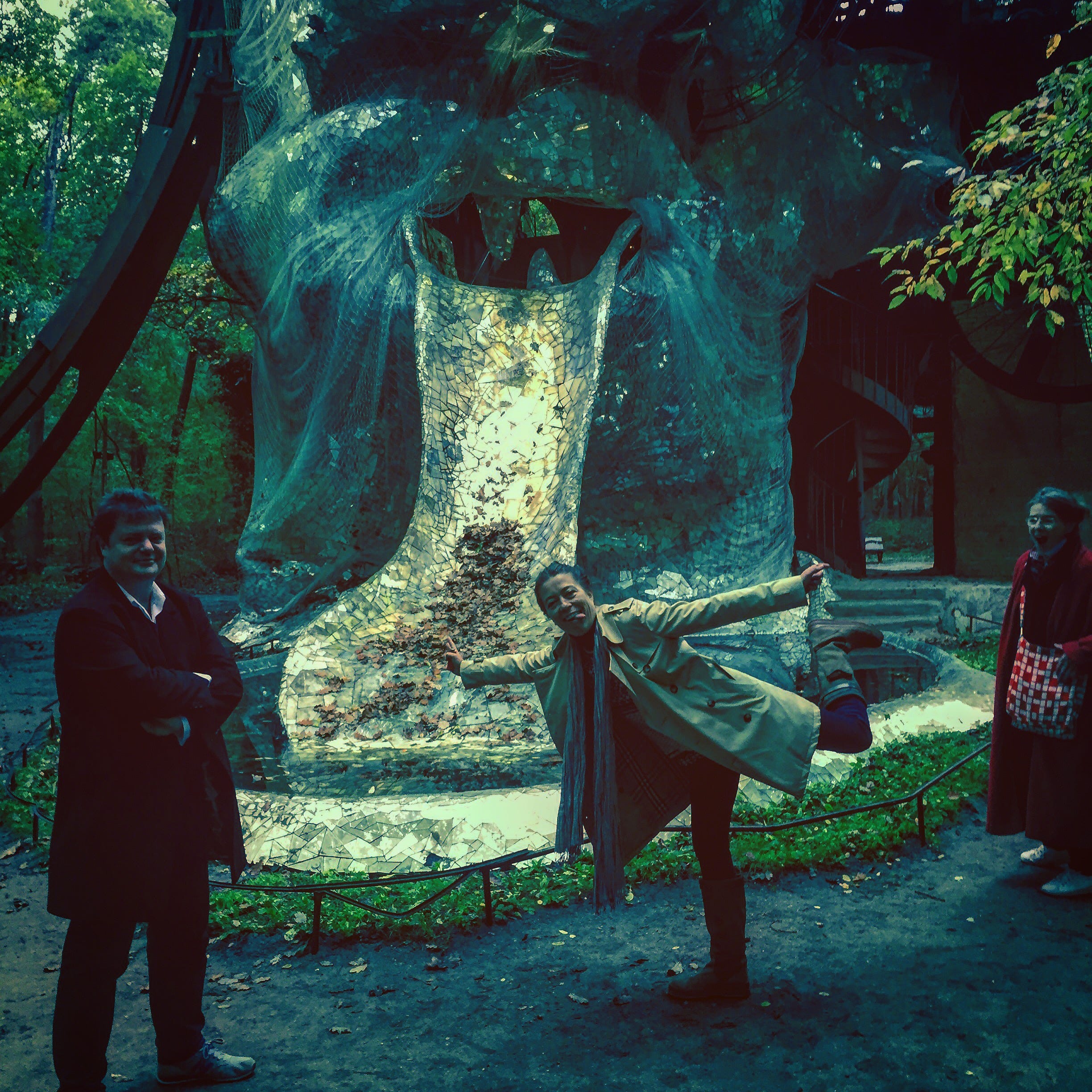
Bloum’s standing in this flamboyant court with all its artistic royalties, monsters, magicians and jesters, was that of a free child, running around half naked playing in Le Cyclop and the forest surrounding the sculpture. “I always felt completely safe. Everyone knew that if anything happened to me, my father would kill them. This was clear. To Niki and Jean, I was the grandchild they never had together. To Pontus, children of artists were heirs who interfered with art. As a grandchild, there was no such complication.”
“I always felt completely safe. Everyone knew that if anything happened to me, my father would kill them.”
I believe Bloum when she reveals that her young friends told her “yeah, I’m sure”, when she asked if they’d like to come along and play in her grandfolks’ giant monster in the forest. The scenes she has narrated through the years, from Le Cyclop and elsewhere, makes me think of Bruegel paintings. Here the spirit of the sixties survived into the eighties. Something fantastical was always going on. Everything was possible. Anything could happen at any time.
My favorite story is one with Bernard Luginbühl, Tinguely’s old friend and main collaborator with Le Cyclop, a heavier, more brutal version of Tinguely, in his machine sculptures and in his physical appearance. Bloum confides that though he was actually kind and sweet, she was a bit afraid of Luginbühl as a child, understandably with this enormous figure, with long sloping mustaches, clad in ancle-long black leather coats, speaking “even worse swizzedutch than Tinguely,” frequently barbecuing for feasts in the forest meadow in front of Le Cyclop. “I didn’t know what a Nazi was, but I figured it could be someone like him,” Bloum says. One night on a terrace in Le Cyclop, with torches burning and fireworks erupting, she eyed a horrifying sight—Luginbühl in his standard getup, complete with a leather uniform cap, barbecuing a doll (!) the size of her four-year old self (this was on the film set for Niki de Saint Phalle’s surrealistic fairy tale Un rève plus long que la nuit, launched in 1976). “I thought that if he could do that to a doll, then what could he do to me ..?” Bloum says.
…she was a bit afraid of Luginbühl as a child, understandably with this enormous figure, with long sloping mustaches, clad in ancle-long black leather coats, speaking “even worse swizzedutch than Tinguely,” frequently barbecuing for feasts in the forest meadow in front of Le Cyclop. “I didn’t know what a Nazi was, but I figured it could be someone like him”
She portrays Niki, Jean, Pontus and most of their friends as rebels and anarchists who lived for art, and didn’t care about much else. “They were all vandals, bandits, thieves—punks before there was a word for it. They were totally honest. They gave you real. They believed that there were frontiers to be crossed and conventions to be shattered. They took what they needed to achieve what they wanted. They believed in ethics, but not in morale.”
Her grandmother Niki de Saint Phalle, Bloum depicts as a near supernatural dark hero queen of the avantgarde, surrounded by a following of gay admirers, all of whom became Bloum’s family. “She used her beauty as a gun. In her young age, she must have been terrifying, extremely violent. When Nine-Eleven happened, she told me that she could have been one of those terrorists if it wasn’t for art.”
“When Nine-Eleven happened, she told me that she could have been one of those terrorists if it wasn’t for art.”
Bloum explains that her relationship with her grandmother was, not surprisingly, affected by Niki’s history with her own children. “She was fantastic with me because of her feelings of guilt. She struggled with her instincts to spoil me because of this. Niki really was a witch in the sense of the Middle Ages — a woman of tremendous strength, even if she was frail. My mother is a delicate, magic being, all to herself, outside of this world.”
Pursuing the trail of ancient saga, Bloum describes the couple Niki and Jean as an incarnation of “The Beauty and the Beast” in Jean Cocteau’s classic film from 1946. “When Jean was sleeping, snoring, he was The Beast, totally. Then you could sense the potential of violence.”
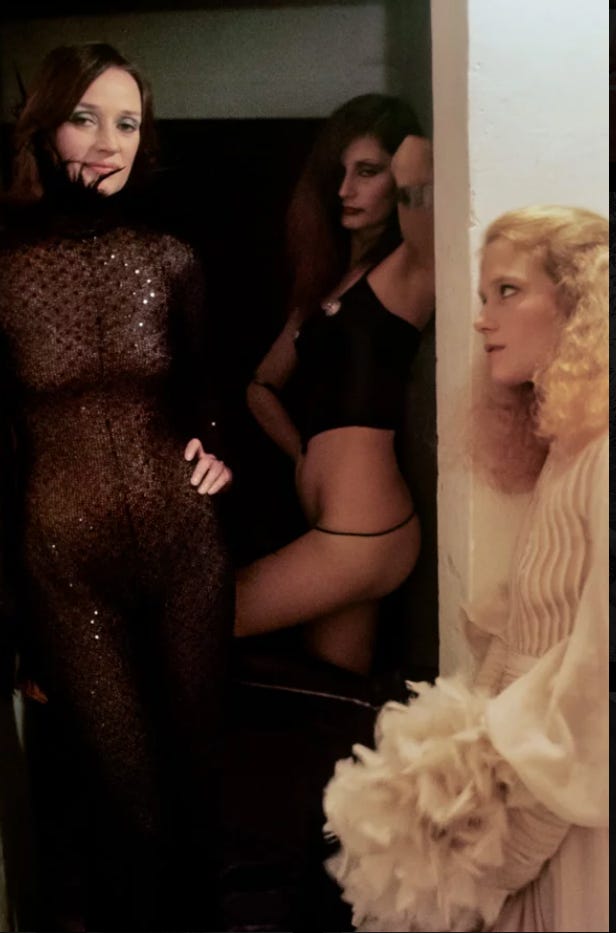
In our moralistic times, some may flinch when Bloum pictures her adopted grandfather Tinguely not just as a The Beast but also as the subject of her romantic love. “I was madly in love with him as a three-year old child”, Bloum says. “I was jealous of Niki, trying to convince Jean that I could love him more than she.” To impress Tinguely, Bloum later dressed sexy for his openings. She especially remembers the magnificent release party for his retrospective at the Palazzo Grassi in Venice, under Pontus Hultén’s directorship, for which Bloum donned a daring appearance which made Tinguely proud. She stresses that this role play was a perfectly innocent game. “It was completely platonic and very beautiful. Jean was so sweet, so generous and protective with me. I don’t believe his own children ever knew that side of him.”
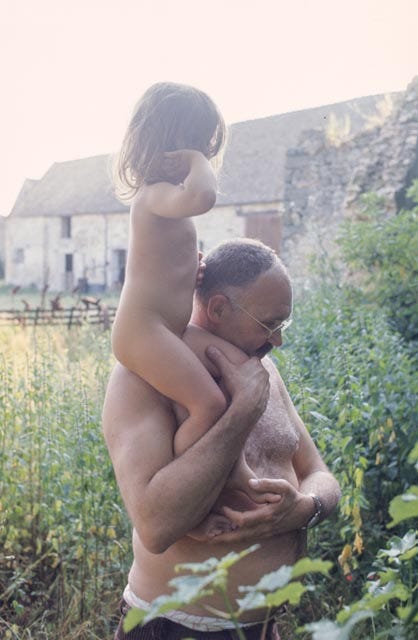
As a grandmother, Niki de Saint Phalle’s concerns for Bloum were far from those expected from a cliché old granny. Another favorite tale is that of when Niki summoned Bloum and her husband Bouba Cárdenas, who Niki loved, for some elder counselling. “When you are unfaithful to each other, lie about it,” Niki stated. “Jean and I were always honest, which only caused trouble.” “I thought, well thank you for giving my husband this advice,” Bloum says, smiling.
With Pontus Hultén, Bloum describes her relationship as easy. “As a small child, I felt closer to that side, to Jean and Pontus, than to Niki. To Pontus, after being a child, I became a worker, a part of the team. As a communist, that was important to him.”
For almost half a century, the lives and careers of Pontus, Jean and Niki were intertwined in a web of love, creativity, friendship and mutual dependance, ever since Hultén and Tinguely first met in Paris in 1954, after Pontus had visited Jean’s show of small Calder-inspired wire sculptures at the bookstore of Galerie Arnaud, and left a note, until Niki’s death in 2002.
Hultén and Tinguely partnered in an anarchistic approach to life and art, with nihilist inclinations, never accepting, much less respecting the restrictions forced on the individual by society, tradition, capitalism or bureaucracy. From their first encounter, they engaged in endless dialogue, and in a suite of creative collaborations that jumpstarted with the Le Movement show in Galerie Denise René in Paris in 1955, a first breakthrough for them both. Their thirty-seven years of nonstop creative exchange was crowned with the great Venice retrospective at the Palazzo Grassi in 1987, which traveled to Centre Pompidou and other venues, and capped with Tinguely’s final show in Moscow in 1990, from the opening of which there are bizarre anecdotes.
Their thirty-seven years of nonstop creative exchange was crowned with the great Venice retrospective at the Palazzo Grassi in 1987, which traveled to Centre Pompidou and other venues, and capped with Tinguely’s final show in Moscow in 1990, from the opening of which there are bizarre anecdotes.
It was Tinguely who terminated Hultén’s own artistic career. Throughout his youth, Pontus’ dream was to be an artist, while he also studied art history and arranged exhibitions from a young age. Though he was active as an artist into the sixties, even after becoming museum director, he obviously abandoned his personal ambitions after meeting Tinguely. According to Seppi Imhof, the master welder, Tinguely’s assistant for twenty-five years, who spent more time with Tinguely and Hultén together than anyone else alive today, the two had a bond. “Pontus realized that Jean was better, so they made a deal that Jean should make the art and Pontus write about it,” Imhof says. “Both were equally dependent on the other.”*
Niki de Saint Phalle met Pontus Hultén at the Impasse Ronsin, where she moved in with Tinguely in 1960, in the studio where he had previously lived with his first wife Eva Aeppli. Niki first collaborated with Pontus in the Art in Motion show at Moderna Museet in Stockholm in 1961, where she staged two of her Tier performances. Henceforth, the trio, de Saint Phalle-Tinguely-Hultén, formed a joint force in art world.
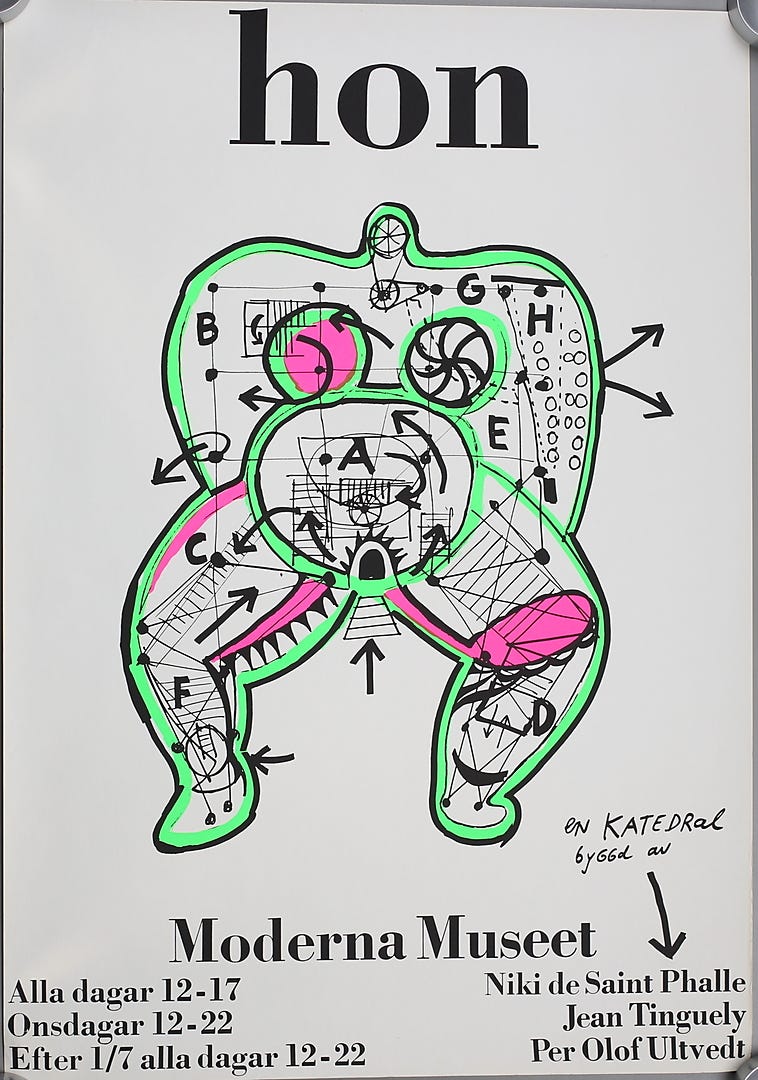
For Niki de Saint Phalle, hon* in 1966 was a global breakthrough. She and Tinguely became known as “The Bonnie & Clyde of art.” Niki’s outsize Nana, a figure she had launched at exhibitions the year before, in 1965, stole the show at Moderna Museet, overshadowing her colleagues Tinguely and Swede Per Olof Ultvedt, becoming Niki’s global trademark.
Though hon was motherly rather than sexual in her nature, the sensational, enduring success of the exhibition doubtlessly can be linked to “Swedish Sin,” a powerful myth launched around the same time. The show boosted Pontus Hultén’s radical international reputation. Likely, it was the main source of his sobriquet “The Swedish pornographer,” coined in French press on his subsequent return to Paris.
Surely, Pontus and his colleagues expected hostility not least from feminist activists in the emerging sixty-eight movement. To his astonishment, the anticipated moralistic outcry never quite disgorged. Pontus was known for wanting the press to report from the museum every day, positive or negative, a feat accomplished with many spectacular initiatives throughout Moderna Museet’s “heroic years” (usually considered from 1961 through 1968). The morning after the hon opening, Hultén eagerly browsed the morning papers, to find—nothing. The museum had encountered a known media phenomenon. When faced with something new and unexpected, journalists and others sometimes don’t know what to think, write or say, and therefore remain silent. According to Hultén, it wasn’t until the international press shortly after featured articles that Swedish media started reporting daily, fueling the exhibition’s overwhelming public success.
hon gave birth to a family of brainchildren. The eldest was Le Paradis fantastique, the sculpture group which since 1971 adorns the entrance to Moderna Museet in Stockholm.
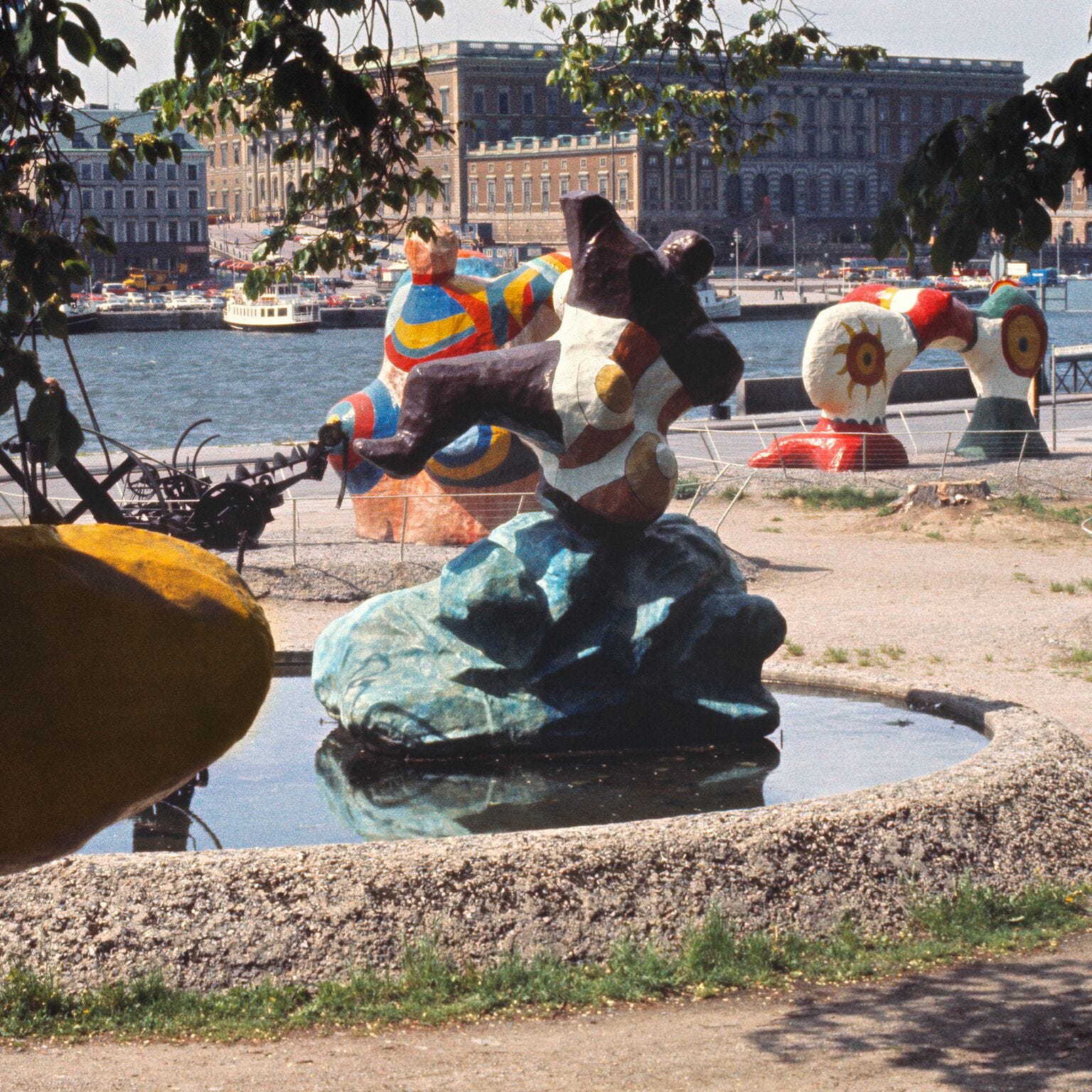
With hon, Niki’s Nanas and Jean’s machines in combination became a hallmark. The year after, 1967, Tinguely and de Saint Phalle were commissioned to create a monumental sculpture group for the roof of the French pavilion of the world expo in Montreal. Here the dots with Hultén again aligned. Commissioner for the French pavilion was Robert Bordaz, the founding president of the Centre Pompidou, who would, six years later, recruit Pontus to the new Musée national d’art moderne.
When the Montreal expo concluded, there was no interest from French institutions for the sculpture group, far too radical for the conservative French museum establishment at the time. Le Paradis was moved temporarily first to the sculpture garden of the Knox Albright Museum in Buffalo, then to Central Park in New York, where it became a popular attraction, spread out for around a year on a lawn near 110th Street, south of the Harlem border.
With the future of Le Paradis in flux, Hultén seized the chance to grab the group for Stockholm. de Saint Phalle and Tinguely enthusiastically agreed, donating the work to the museum “so that the children can come home to their intellectual habitat.”
With the future of Le Paradis in flux, Hultén seized the chance to grab the group for Stockholm. de Saint Phalle and Tinguely enthusiastically agreed, donating the work to the museum “so that the children can come home to their intellectual habitat”. The group was secured for Stockholm in a complex operation, requiring a controversial grant from the Swedish government, sponsoring from a shipping company and a donation from Dominique and Jean de Menil, the French-American patrons to whom Hultén had been introduced by de Saint Phalle and Tinguely, crucial supporters of the careers of all three of them.
It must be impossible for younger generations to imagine the wrath that Paradis evoked when installed, after a year in the workshop, on the quay of Skeppsholmen island, across the bay from Stockholm’s Royal Castle. In our time, when collecting contemporary art is a favorite pastime among more sophisticated billionaires, one must remember that around 1970, modern art was still despised by the conservative establishment. Moderna Museet was loathed by the right as a nest of obscenity and revolutionary propaganda. Niki’s frivolous Nanas insulted the masculine pride of the Royal Navy, which for centuries had quartered on Skeppsholmen, forced out from the island by these dreaded bolsheviks. Most alarming: this so-called art was exposed in the face of the King when the poor old chap stepped out on his balcony in the morning!
Le Paradis is a milestone that in its turn spawned multiple Niki and Jean collaborations around the world, including at the Giardino dei Tarrocchi, Le Cyclop, and Fontaine Stravinsky. What shame that the conservatives were ultimately successful, after fifteen years of relentless struggle, when the sculpture group was moved to its present, less visable location as late as 1986, when political strife was practically over.
Bloum Cardenas confirms that the creative origin of hon, the “primal mother” of all this artistic offspring, is a delicate matter. “It was sensitive that it was Pontus’s idea. Also, it’s one of just two Nanas* that Niki ever made that’s lying down on her back. Clearly, this was the guys’ idea. Niki’s Nanas are never passive.”
Bloum emphasizes that hon had even further ramifications in that she kicked off Niki as an architect (and, less noted, also spurred Tinguely to think bigger, with Le Cyclop). After hon, Niki and Jean both worked in the larger scale for the rest of their lives. “This wasn’t Pontus’s idea,” Bloum says. “Niki was thinking in terms of architecture even before—the body as architecture, with the Nana-maison.*”
In addition to friendship, love, and devotion to art as their highest order, there were business aspects to the mutual interests of Niki, Jean and Pontus, including rivalry and conflicts. Seppi Imhof remembers the Tinguely and Hultén encounters: “There was a lot of shouting when they met, these two machos. Pontus always wanted something when he came to see Jean. It was the same with Jean. He also always wanted something when he saw Pontus.”
The fact that Pontus Hultén was a principal proponent for Jean Tinguely and Niki de Saint Phalle is common knowledge, promoting both artists throughout his career. In her portrait of Pontus,* Niki writes about how he frequently came through with decisive ideas and connections for her and Jean. Less known, perhaps, is that support worked both ways. Niki and Jean were critical for Pontus’ career, not just with their shows, but also through their contacts.
The reasons why Pontus Hultén was recruited to Centre Pompidou are complex. What’s undisputed is that Niki and Jean’s lobbying was indispensable—long before the Centre Pompidou project was initiated. Some of Hultén’s most important sponsors and allies, notably Dominique and Jean de Menil, were friends of Jean and Niki. Many of the collaborators Pontus recruited for his team at the new museum were endorsed by the very same “Bonnie & Clyde of art”. One was Daniel Abadie, at the time a gifted, fearless young curator and dealer. To me, Abadie stressed the couple’s importance as ambassadors for Hultén in Paris. “Jean and Niki were called the nutcracker,” Abadie said. “One came from one side, one from the other. You were crushed in between if you didn’t do as they wanted.”*
“Jean and Niki were called the nutcracker,” Abadie said. “One came from one side, one from the other. You were crushed in between if you didn’t do as they wanted.”
Later in his career, too, Hultén’s fortunes intermingled with those of de Saint Phalle and Tinguely. His ties with another power couple in the art world, Giovanni “Gianni” Agnelli, the FIAT executive and global jet set playboy, and his wife Donna Marella Agnelli, born Princess Caracciolo, can be tracked back to the fifties, when Niki and Marella Caracciolo befriended each other as models in New York.* The Hoffman-Sacher-Oeri family in Switzerland, owners of pharmaceutical giant Hoffman La Roche, was another patron to whom Hultén was introduced by Tinguely. There were many others. Niki’s and Jean’s connections should not be underestimated.
Pontus Hultén’s eight plus years at the Centre Pompidou are full of fond childhood memories for Bloum Cardenas. “I played in the museum and at his desk in the vast open office landscape,” she says. “I was the only kid who was allowed to run around there all by myself. I specifically remember having fun with Pontus’s trash.” Any child should envy her memories from Le Crocodrome de Zig et Puce, the giant dragon nested in the submerged Forum Arena in the entrance to the Centre at the opening. The Crocodrome was another monster baby of hon—a mammoth sculpture with a variety of other artworks and attractions “swallowed” in its intestines. “Oh my God, that was so crazy, what a privilege—and of course they hid in there to scare me a little bit more than everyone else!”
His aura of power influenced Pontus’s persona and the way people interacted with him, Bloum recalls. Yet, even at the height of his reign, riding the wave of success that followed the museum’s opening in 1977, he never betrayed the mischief anarchist spirit he nurtured with Tinguely. A huge exhaust pipe of the kind that line Place Beaubourg above the piazza, opposite the museum—a Centre Pompidou trademark—embellishes Le Cyclop, snatched on a dark night by team Tinguely with the good will of the museum’s director.
Bloum enlightens me to an interesting observation — the marxist class structure of this trio: the aristocrat, Niki, the haute bourgouise, Pontus, and the libertarian proletarian, Jean. “Pontus was the intellectual. We all benefitted from his smartness and knowledge,” she says.
This social order may explain some differences in views in various matters, specifically with people and money. “Pontus believed in people, that they had all these possibilities. Niki was afraid people. She didn’t trust them. Jean’s idea was that people deserved better. They all had this Christian thing about giving back to people through art. With money, they all had individual relations. Most important, they shared the faith that art belongs to all and should end up in public spaces and museums.”
After Jean Tinguely’s death in 1991, arranging his estate was an enormous task for Niki de Saint Phalle, to whom the artist had left everything. Tinguely was a manic collector who possessed copious amounts of things, in addition to his colossal artistic production. Niki’s health was fluctuating at this time. She needed all the help she could get from Pontus in sorting out Tinguely’s estate and various homes, storages etcetera. Tinguely’s old friend Eberard Kornfeld, the Swiss dealer and collector, also assisted in this dire endeavor.
In his lifetime, Tinguely planned a museum of his own in La Verrerie, a factory he had bought, near his hometown Fribourg, with halls big enough to house his largest machine sculptures. The site was remote, hard to access and complicated in other ways. Here, Tinguely intended to exhibit, in addition to his own art, work by his friends such as de Saint Phalle, Lunginbühl, Eva Aeppli, Daniel Spoerri, Yves Klein and some other noveaux realistes. He expected Hultén to execute these plans as director. “Pontus didn’t like that”, Seppi Imhof said. “He didn’t want to be told what to do.”
Realizing the idea for a Tinguely museum was a formidable quest. Fortunately, there was a natural patron in Paul Sacher, the music conductor who was at the time the patriarch of the Hoffman-Sacher-Oeri family, owners of Hoffman La Roche. His late wife Maja Sacher was a major collector of Tinguely’s work. The artist had for years discussed plans with Sacher for a museum on the family compound outside Basel. According to Niki, the magnate immediately accepted to finance the museum when she asked him at Tinguely’s storied funeral in Fribourg. She herself donated fifty sculptures and a collection of drawings and prints for the purpose.
An agreement was soon reached that the museum should be built not in Sacher’s estate, but on a property by the Rhine in central Basel, provided by the municipality. Time was tight as it was decided that the museum should be inaugurated for Roche’s centennial anniversary in 1996, allowing just two years for construction. That Pontus Hultén should be the founding director was a given. As architect, Hultén advocated his friend Renzo Piano, to no avail. The Swiss postmodernist Mario Botta, who had been involved in the museum plans with Sacher from the beginning, was commissioned. Disappointed, Hultén cared only about the galleries and installment of the art, leaving the rest of the architecture and the program to others. After little more than a year, his final international museum commission was complete, appropriately for the artist who had been his professional and spiritual brother from the outset.
For Pontus Hultén, a pseudo-religious faith in art as an instrument to improve society was fundamental. He urged art to escape the studio, interrupting, disturbing, intervening with society, collaborating with other artic expressions, architects, engineers, politicians, philosophers etcetera in creating a better, more beautiful and pleasant world. Fantasie au pouvoir!, Fantasy for power!, was his credo—a slogan said to have been scribbled on the walls in the streets of Paris during the sixty-eight rebellion. Niki de Saint Phalle and Jean Tinguely honored these ideals.
In our present day, such visions seem alien. Pontus Hultén was a utopian of rank. He saw artists as semi-gods with might to transform society. He believed in the revolutionary potential in art. Already in the late sixties, he realized that the time had passed for this grand vision—a lasting disappointment for him. When the House of Culture project in Stockholm—which inspired Centre Pompidou—collapsed, he saw it as evidence that “time was losing its breath”. In my interview with him, he said: “Today, when the utopias are dead, it seems crazy. We were a bit naïve, but not at all as naïve as it may appear today, Had we gotten started a few years earlier, we might have pulled it off.”*
In the eighties, a shift occurred. It’s well known that this was the decade when money subdued art. It’s more rarely discussed that it was also the time when trends and intellectual snobbery proliferated. Germano Celant, the late influential Italian curator and art historian, phrased it well: “Until the eighties, art was tied to culture and society. Now it’s linked to business and power. Pontus was the first curator. Today everyone is a curator.”*
In our cool, commercially streamlined contemporary reality, Jean Tinguely, Niki de Saint Phalle, and the view on art that they represented with Pontus Hultén, fell somewhat out of vogue for a few decades. It’s gratifying to see new mounting interest in them and their ideals. Dare we see this a sign of a comeback for a more active, political, inclusive role for art? “It’s inevitable,” Bloum says. “These guys are so contemporary. It’s great to see that they are more easily understood by younger generations than by their own. Their spirit is so much needed today.”
*Seppi Imhof interview Basel, 9 December, 2014.
*At the time, but not now, hon was consequently spelled with a minor-case h.
*The other is Le couple
*Nana-maison, 1965-1966.
*Niki de Saint Phalle, ”Ein Portrait von Pontus”. Das gedtruckte museum on Pontus Hultén, Kunst- und Austellungshalle der Bundesrepublik Deutschland/Cantz, Bonn, 1996.
*Daniel Abadie, interview Paris, 22 October, 2015.
*Marella Caracciolo was portrayed as one of the “Swans”, Manhattan’s most glamorous women, by Truman Capote in “Breakfast at Tiffany’s” from 1958.
*Pontus Hultén, interview Stockholm, 16 December, 1996.
*Germano Celant, interview Milano, 18 April, 2016.
Related articles:

Pontus Hultén—den moderna konstens anförare

Min mångfaldigt prisbelönta, mycket omskrivna biografi över Pontus Hultén publicerades 2022 (Albert Bonniers förlag). Boken bygger på nio års research- och skrivarbete, med bland annat över 200 intervjuer utförda i 11 länder. Boken fick strålande recensioner och har, måste jag påstå även om blygsamhet är en dygd, blivit en klassiker. Läs citat om boken …
Paris launch of Pontus Hultén—den moderna konstens anförare.

Paris launch of my biography Pontus Hultén—den moderna konstens anförare (original Swedish edition) at the Institut Suédois in Marais in Paris, 22 October, 2022. I was most happy that all of the Centre Pompidou leadership attended, marking the start of our collaborat…
Talk with Jean-Hubert Martin at Paris launch event for Pontus Hultén—den moderna konstens anförare

What a wonderful launch event for Pontus Hultén—den moderna konstens anförare (the original Swedish edition) it was at Le Cercle Suédois, The Swedish Club, in its historic premises in Rue the Rivoli, facing Les Jardins des Tuileries, since sadly defunct. Lovely intimate talk with …
Breakfast launch event for Pontus Hultén—Commander of Modern Art

On 20 June 2025, the English language edition of my biograhy Pontus Hultén — Commander of Modern Art was launched at a breakfast event in the garden of the Institut Suédois in Paris’ Marais quarters, with a talk with myself, Institut Suédois director Sara Arrhenius and Stina Gromark Pariente, the Sw…
Speech on Pontus Hultén and the Brillo Scandal

Speech on the Brillo scandal, `L’Après Pontus´—the Brillo Scandal, at Centre Pompidou:s 2-day symposium Colloque International: Pontus Hultén. Retour à la source, Grand Palais, Paris, 20-21 November, 2025. It was the first time that the Brillo scandal was addressed in Paris. Film from the speech coming.
Original Stockholm book launch Pontus Hultén—den moderna konstens anförare

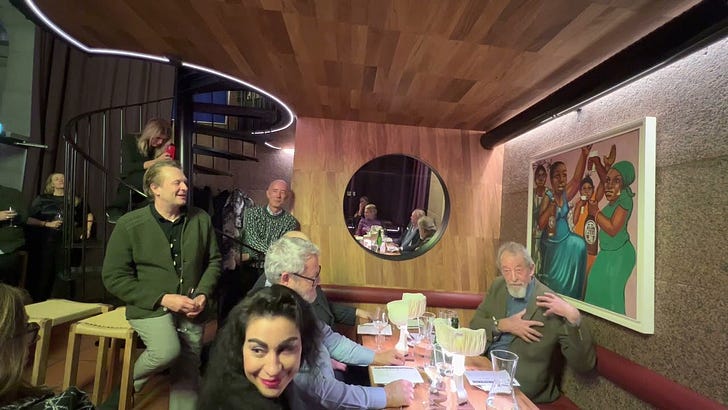
Our splendid release cocktail for Pontus Hultén—den moderna konstens anförare. Hosten by my publisher Albert Bonniers Förlag at their Nedre Manilla mansion, Royal Djurgården. After party at “Lägenheten,” Sturehof restaurant, Stockholm, 1 September, 2022. A beautiful memory for life!
Moderna Museet The History Book

In 2007, we with BrittonBritton won a competition for the honorable commission of designing, image editing and and producing the heavy coffee table book for Moderna Museet’s (The Modern Museum’s) 50-year anniversary book in 2008, called simply The History Book